
Lens-Artists Challenge #412—Places Shaped by Water
Water can take various shapes and sizes and colour but what when the smooth blue/green is replaced by spots. It is esoteric.
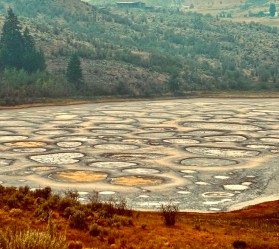
One such unique waterbody is the Spotted Lake or Lake Khiluk its indigenous name. To my 10 year old granddaughter it is ‘poxed’.
Google has the answer for this: Spotted Lake is a mineral lake, rich in calcium, sodium sulphates and magnesium sulphate, among others. For most part of the year it is a regular lake as these minerals float just under the surface and resurface during the hot summer weather that the valley is known for. Much of the water in the lake evaporates and the leftover minerals form spots. Over the summer months these spots change size and shape, from blue to green to yellow, depending on the minerals that make up each spot.
We were unlucky to just see few shades of yellow, maybe our weather timing was wrong. Another regret… visitors are not allowed to step beyond the wires and the fences. There were a few enterprising youngsters who walked through the rocks and thorns to click pictures.
To reach the area, take Highway 3 west out of Osoyoos for about 10 kilometres.
According to Destination Osoyoos, “Spotted Lake is known to the First Nations People of the Osoyoos area as kłlilx’w, and it is a sacred site that has been considered a revered place of healing for centuries. The belief is that each of the different circles holds its own unique medicinal and healing properties. The land surrounding the lake was privately owned for 40 years, but in 2001 the federal government acquired it for the benefit and uses of the Okanagan Nation. This ensures that this historically important land can be protected from development, so that future generations of the Okanagan Nation will continue to benefit, as did their ancestors. It also ensures that future visitors will still be able to view this incredible natural phenomenon.
If interested in learning more about the Okanagan First Nation, The Nk’Mip Desert Cultural Centre is a great place to explore and learn more about their rich cultural history.”
More of Osoyoos in next post.


6 responses to “TOUCH of ESOTERIC….THE SPOTTED LAKE”
Fascinating! It’s a great subject for the challenge.
Thank you
What a fascinating story! The photo captures the lake very well.
Interesting.
This is so unusual. One would swear on first glance that it was something toxic.
It is toxic and fenced