

Kumbh Mela Evening View 2025.(Google)
What does one say or write when they find their city splashed across print and visual media for hosting the present world’s largest religious congregation attended by VIPs and the junta from across the globe. Feel pleasure/pride/privilege…..
The town is Prayagraj and the event is the 2025 Kumbh Mela, wrapped around Hindu myths and beliefs, featuring in UNESCO world heritage list. The Kumbh Mela is held every twelve years and with each appearance bloats in size to accommodate the aspirational desires of the organizers and attendees. A dip in the holy waters during this period of 21 days is Moksha or salvation i.e. cleansing mind and body.
This year it is once-in-144-years event for 44 days expecting 400 million footfalls. There is awe and scepticism all around as managing the crowds is another wonder in itself. There are many firsts including Radio frequency wristbands to solve the problem of pilgrims getting lost and separated, a favourite theme of Bollywood movies; underwater and aerial drones deployed to help monitor security and movement of the bathers; the 2000 Drone light show illuminating the skies and various entertainment and educational programs and exhibitions.
I am reading all this and feeling nostalgic as Prayagraj is my birth city and growing-up-backyard till I moved to New Delhi. Visiting has always been a mathematically serious business because one is adding and subtracting from memories and present reality. We, siblings and me, grew up listening to Hindu mythology centered around the three sacred rivers, Ganga, Yamuna and Saraswati and the melas once a year/six years/twelve years. The mythological belief is that God Vishnu, while trying to save the Kumbh or pitcher of the sacred nectar (amrit) from the demons, spilled four drops of nectar in four places, Prayagraj, Ujjain, Nashik and Haridwar. Drinking the nectar would ensure immortality and this resulted in a fight between the demons and the gods that lasted twelve years. The Gods won and the Kumbh Melas are held to commemorate this victory. Prayagraj is on top of the list as it is situated on the banks of the three holiest rivers, the Ganges, Yamuna and Saraswati.
Our sleepy self-possessed town would wake up during this period welcoming, sometimes reluctantly, the devotees and visitors thronging to the ghats. The famous Chinese traveller Hiuen Tsang describes ‘a ritual at a site located at the confluence of two rivers in the kingdom of Po-lo-ye-kia (identified with Prayaga)’. He mentions about hundreds taking a bath at the confluence of two rivers, to wash away their sins. According to scholarly believe Hiuen Tsang’s account is the earliest surviving historical account of the Kumbh Mela. But according to an Australian researcher Hiuen Tsang’s reference may have been about the Five year Mela.
Mark Twain, the famous American writer, visiting India and the Kumbh Mela in the 1890s..writes “The Kumbh Mela seems likely to remain the greatest show on earth for many generations to come.”
“It is wonderful, the power of a faith like that, that can make multitudes upon multitudes of the old and weak and the young and frail enter without hesitation or complaint upon such incredible journeys and endure the resultant miseries without repining. It is done in love, or it is done in fear ; I do not know which it is. No matter what the impulse is, the act born of it is beyond imagination marvelous to our kind of people, the cold whites” (FOLLOWING THE EQUATOR)
Whatever… the presentations and descriptions of past and present visitors, writers, preachers, scholars, seekers and givers make us aware of the magnanimity and resilience of the three holy rivers.*
Sacredness apart… to us the Rivers were the entertainment we needed during the hot boring summer school breaks. For two months we would be up before sunrise, piling into the family car, heading to the river banks and onto our private boat and to the mythical confluence of the rivers. An hour spent in the cool waters was the elixir we needed.

Winters were for leisurely boating with visiting relatives and family or watching the sunrise and the sunsets with the golden globe (sun) lighting up the watery ambiance to the sound of temple bells and chants of the sadhus (holy men). On later visits I would prefer the pleasure of my feet sinking into the wet sands while contemplating the gentle flowing waters or the boatmen splashing homewards.
I vaguely remember my parents and relatives talk about the stampede of 1954 Kumbh Mela (after India shirked off the Colonial rule) and how my mother and aunts were saved from the mob on the newly constructed Pantaloon bridge. Thereafter during subsequent Kumbh Melas the auspices bathing days were avoided by family. We would visit the sprawling grounds and the numerous eating places and stalls selling trinkets on non-bathing days. The various Akharas or camps of prominent Mahatmas and Sadhus were left to the adults and so were the parades of the ash-smeared Naga or naked sadhus. Aunts would cover the eyes of us girls, ( me and cousins) till we were at a safe distance. Sometimes a relative, who was a camp follower, would invite us to their tent and we would stay till the lights came on. For many from the city it was a picnic or a day out. The Melas were simple rustic affairs, more inclined towards faith than the present commercial presentation.

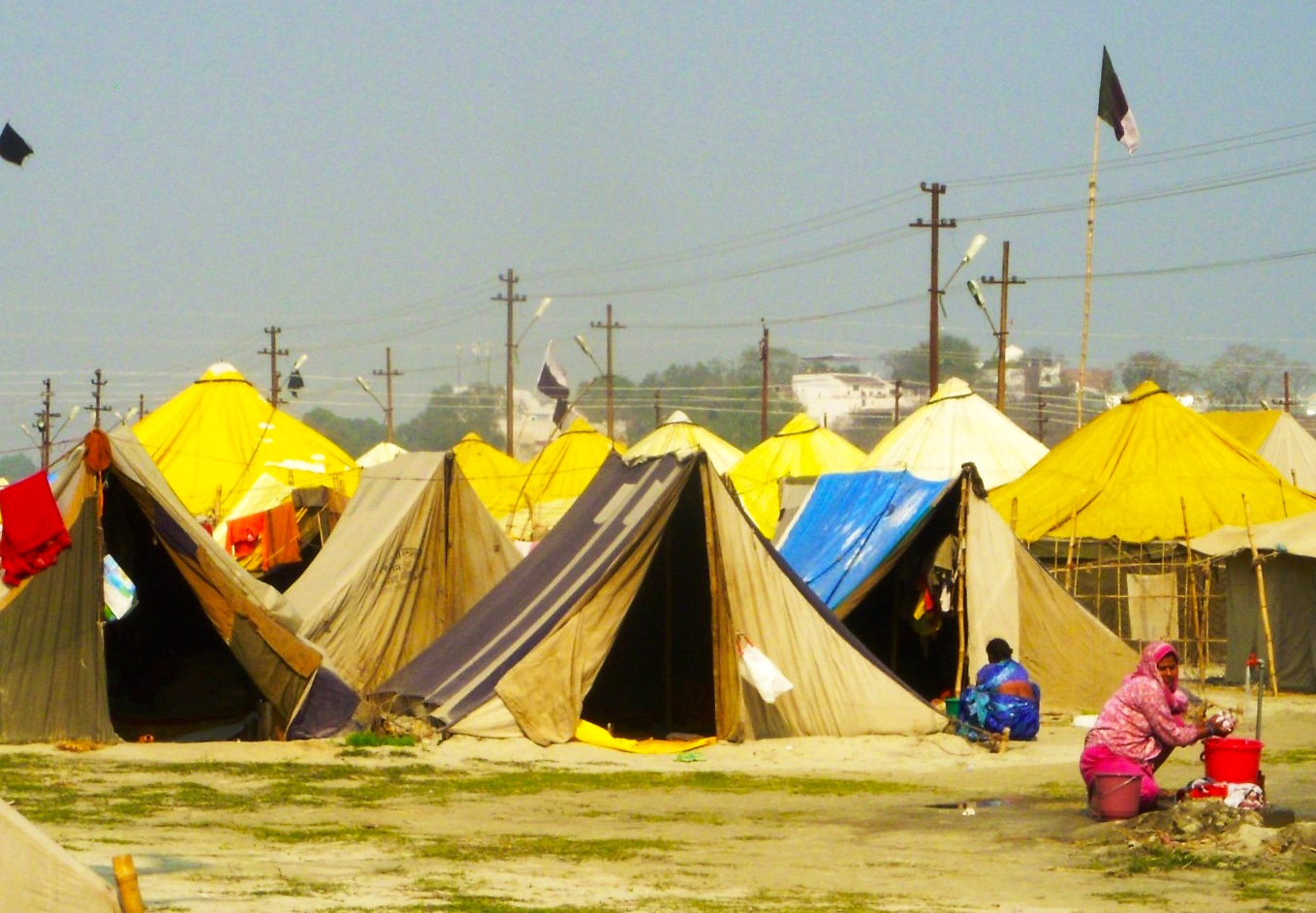
Images from 2013 Kumbh Mela
My 2013 visit to Prayagraj coincided with the Kumbh Mela. Now an adult I took the customary Sangam dip in the holy waters on a non auspices day. It was made possible by a relative who managed to get us VIP passes to a official tent city with facilities of bathing and changing areas. It was a pause moment as I entered the sacred waters, albeit muddy and crowded. During winter months the waters are shallow and it is easy to decipher the muted Ganges and the frolicky blue/green Yamuna become one. The third is invisible due to its mythological existence.
The 2013 Mela was well organized though towards the concluding days marred by the stampede at the Prayagraj Railway Station. A consolation that the incident happened after my visit
Kumbh Mela 2025: As I scan the virtual images I see the infrastructure improvements, the high tech facilities, the well laid out roads and pathways that are a boon for pilgrims trudging miles for instant moksha. Providing modern health facilities, transportation, accomodation is a mammoth exercise with Government and private agencies pitching in their best. I see and read about the high profile visitors, including Apple co-founder Steve Jobs’s wife Laurene Powell, the multitudinous Sadhus and believers adding to the mystique and allure of the Mela. The Kumbh Mela comes across as a mega commercial gathering with luxury tent cities, and fancy entertainment facilities.

2025 January, Prayagraj (Google pic)
As for me, sitting in snow bound Calgary, I am a virtual visitor seeking instant online Moksha.
* Reference: https://en.wikipedia.org/wiki/Kumbh_Mela


7 responses to “Instant Moksha”
What a great tradition carried through the years.
Fascinating post. Thanks for the explanation of the event and it’s history. I.ve see photos on the news but didn’t really understand what was taking place.
Thank you
What a gathering! When I read things like this, it makes me realize how big the world is.
😍
Amazing!
Thanks